Bluespotted Ribbontail Rays: The Shy, Photogenic Icons of the Sandy Bottom
 You are cruising over a sandy plateau, perhaps looking for a Stonefish or just enjoying the sunlight dancing on the ripples. Suddenly, you see a flash of electric, neon blue.
It’s one of the Red Sea’s most stunning residents: the Bluespotted Ribbontail Ray (Taeniura lymma).
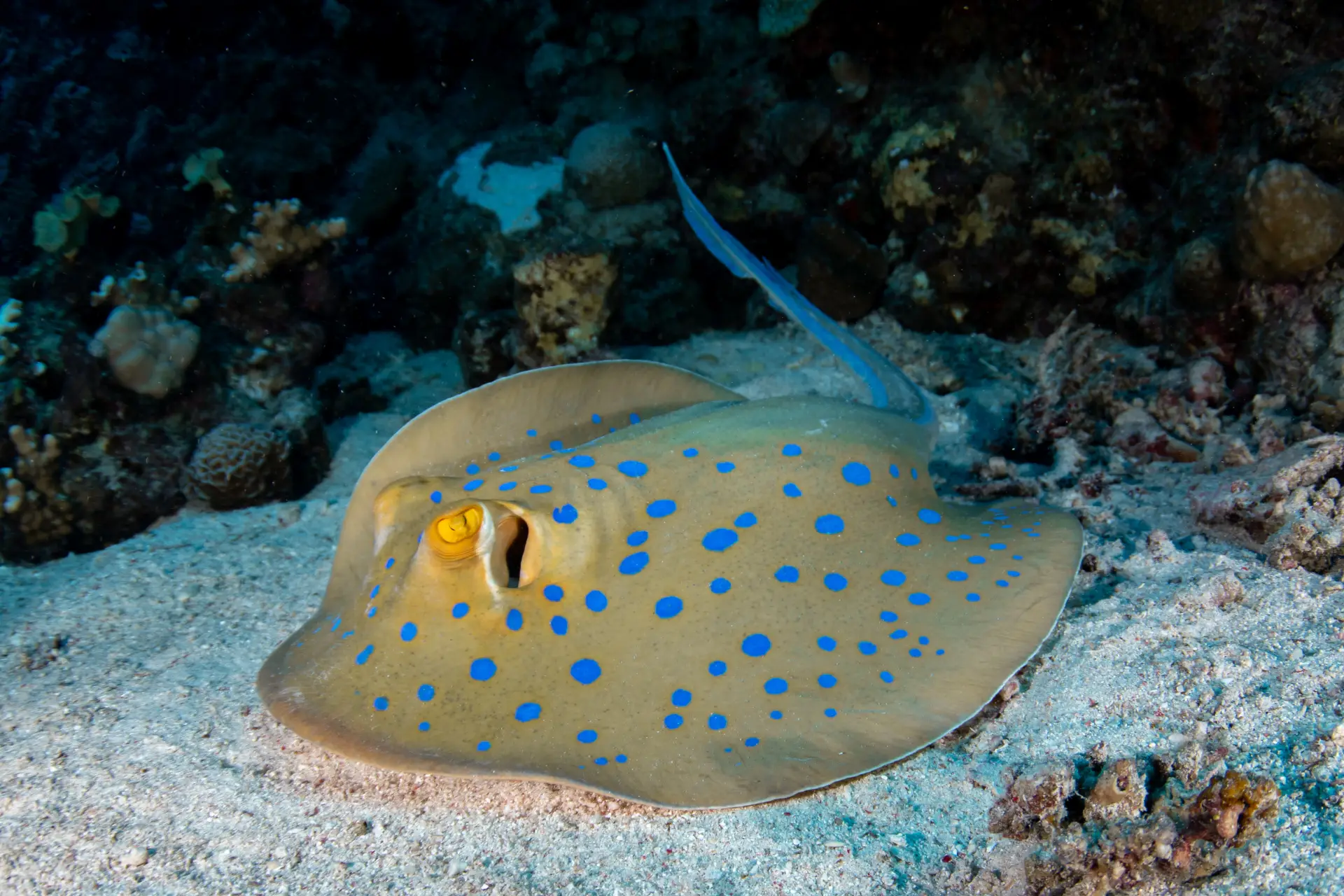
Unlike its larger cousins, the Eagle Ray or the Manta, the Ribbontail doesn’t soar through the open ocean. It is a bottom-dweller, a creature of the sand and the reef crevices. With its bright yellow eyes and polka-dot paint job, it is arguably one of the most photogenic creatures in Hurghada.
But as any underwater photographer will tell you, they are also incredibly shy. At Scubadore Hurghada, we know that spotting one is easy, but observing one takes patience. Here is everything you need to know about the reef’s electric icon.
A Design Masterpiece: Why the Spots?
The Ribbontail Ray is unmistakable. It typically grows to about 30-35cm in width, making it relatively small. But what it lacks in size, it makes up for in style.
-
The Warning: The body is varying shades of greenish-grey to yellow-brown, covered in brilliant, neon-blue spots. It also features two distinctive blue stripes running down the length of its tail.
-
The Purpose: In nature, bright colors usually mean one thing: “Back off.” This is called aposematism. The electric blue spots are a warning sign to predators (like Hammerhead sharks or Bottlenose dolphins) that this ray is armed and dangerous.
The Weapon: Look, But Don’t Touch
That warning is not a bluff. The Ribbontail Ray is equipped with one (and sometimes two) sharp, serrated barbs located about halfway down its tail.
-
Venomous Defense: These spines are connected to venom glands. A sting is incredibly painful and can cause serious infection.
-
The Truth About Aggression: Despite the weapon, these rays are completely non-aggressive. They use their spine purely for defense. The only way to get stung is to accidentally step on one buried in the sand, or to corner/grab one. This is yet another reason why we preach good buoyancy and the “look, don’t touch” rule!
The Excavator of the Reef
While they are often seen resting under table corals during the day, the Ribbontail is an active hunter, particularly at dusk and dawn.
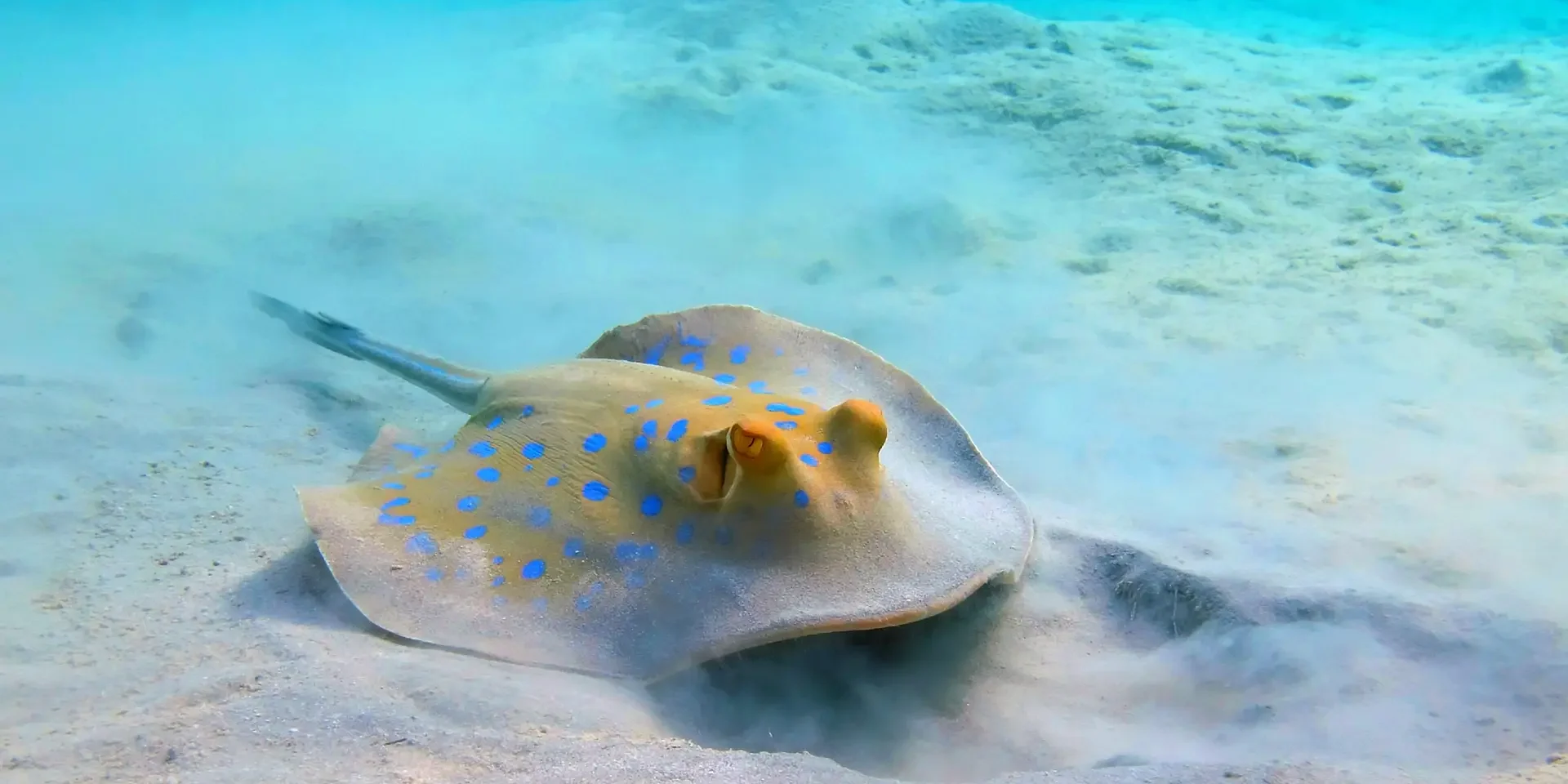
If you are lucky, you might catch one in “excavator mode.” They feed on mollusks, crabs, and worms hiding in the sand. To get to them, the ray will hover over the sand and vigorously flap its wings, creating a suction that blasts the sand away to reveal the prey. Watching a ray dig a crater is a fascinating display of raw energy.
How to Get the Perfect Photo (Without Scaring It)
This is the “photogenic” part. The contrast of the blue spots against the yellow sand makes for an award-winning shot. However, the Ribbontail is famously skittish. If you swim directly at it, it will bolt instantly.
The Scubadore Strategy for Photographers:
-
Get Low: A photo looking down on the ray flattens it and looks boring. You need to get down to its eye level.
-
The Approach: Do not swim straight at its face. Approach slowly in a wide arc, moving parallel to the ray.
-
Watch the Breathing: Look at the spiracles (the holes behind its eyes). If the ray starts breathing rapidly, it is stressed and about to fly away. Stop moving and let it relax.
-
Don’t Crowd: This is where our small group size is a huge advantage. A crowd of 10 divers will spook a ray immediately. A pair of divers moving slowly can often get within inches of a resting ray for a stunning macro portrait of its golden eye.
Why They Love Hurghada
The topography of Hurghada’s dive sites is perfect for these rays. Sites like Gota Abu Ramada and the Giftun Islands offer exactly what they need: shallow, sandy plateaus for hunting, surrounded by coral overhangs for hiding and sleeping.
It is rare to do a week of diving with us and not see a Ribbontail. But seeing one flee in a cloud of dust is easy; watching one hunt or rest peacefully is the reward for the calm, patient diver.
On your next dive, keep one eye on the sand. When you see those electric blue spots, freeze, exhale, and enjoy one of the most beautiful sights the Red Sea has to offer.