Eagle Rays in Flight: The Best Season and Sites to Spot Them Gliding in the Blue

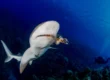
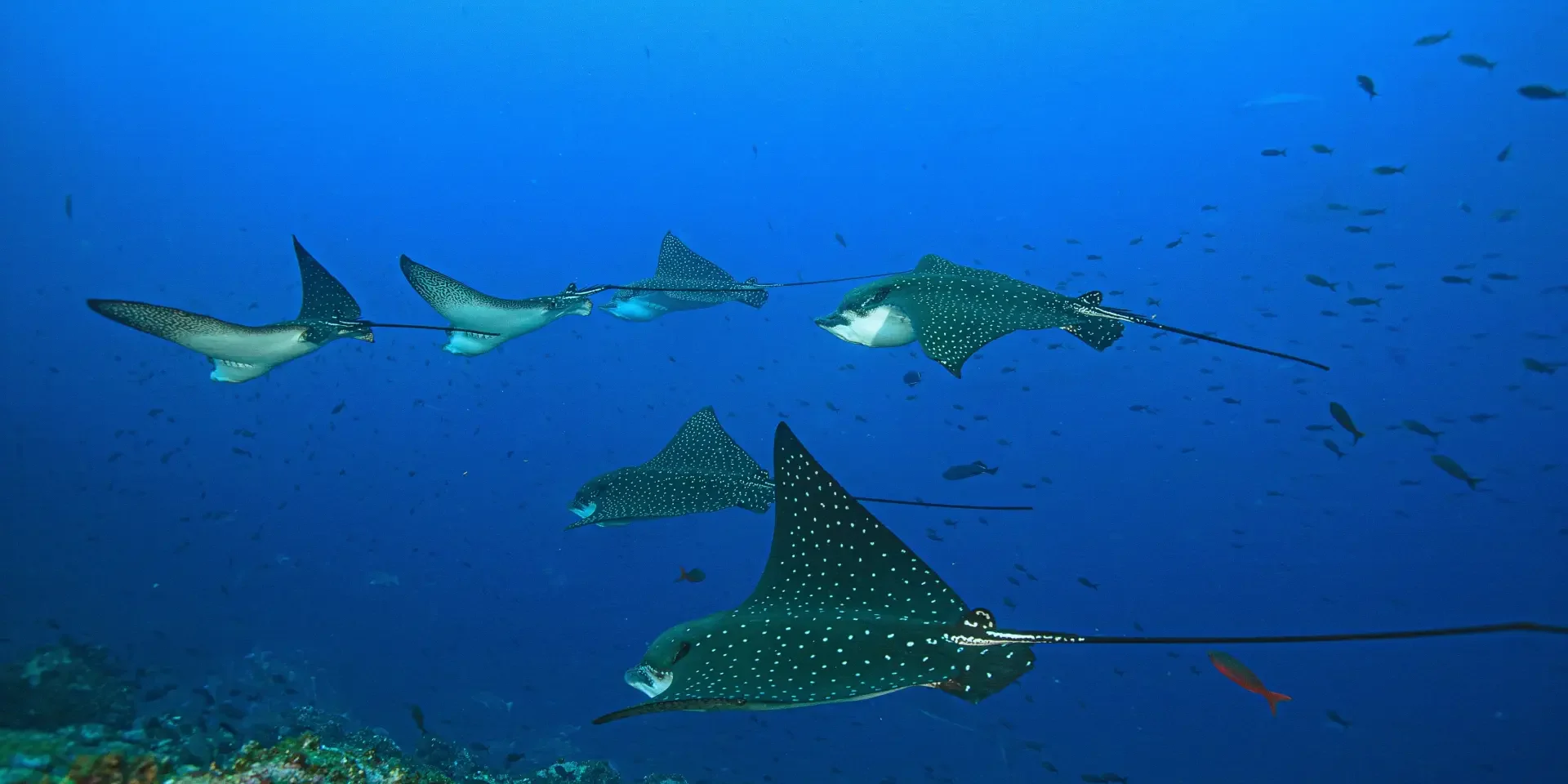
Eagle Rays gracefully gliding in Hurghada
If buoyancy control is the secret to moving like a fish, then the Spotted Eagle Ray is the undisputed master of the skies.
Watching an Eagle Ray underwater is less like observing a marine animal and more like watching a silent, majestic bird in flight. With their pointed wings, distinct polka-dot patterns, and effortless grace, they are one of the most breathtaking encounters you can have in the Red Sea.
Unlike the bottom-dwelling Ribbontail Ray, the Eagle Ray is a creature of the open water. They cruise the reef edges, sometimes alone, sometimes in awe-inspiring squadrons.
At Scubadore Hurghada, spotting an Eagle Ray out in the blue is always a highlight of our week. If swimming alongside these gentle gliders is on your bucket list, here is your ultimate guide to finding them, photographing them, and understanding their unique behavior in the Red Sea.
The Anatomy of a Glider
The Spotted Eagle Ray (Aetobatus narinari) is instantly recognizable, even from a distance.
-
The Wings: They feature a distinct diamond-shaped body with pronounced, angular pectoral fins that can reach up to 3 meters across. They flap these fins in a smooth, bird-like motion to propel themselves.
-
The Snout: Look closely at their face; they have a flat, duck-like snout. This isn’t just for aerodynamics; it’s a highly specialized tool for digging into the sandy bottom to unearth their favorite meals of crabs, mollusks, and benthic worms.
-
The Tail: They possess a long, whip-like tail equipped with venomous spines near the base. However, like most rays, they are incredibly docile and only use their sting defensively if physically grabbed or threatened.
The Best Season for “Flight”
The beauty of Hurghada is that Eagle Rays are year-round residents. You have a chance of seeing one on almost any dive, any month of the year.
However, if you want to maximize your chances, the Spring and Autumn transition months are the sweet spots.
-
May to July: As the water warms up, the reefs become highly active. Rays are frequently seen visiting “cleaning stations” (where small wrasse pick parasites off their wings) and hunting along the sandy plateaus.
-
September to November: The water is perfectly warm, and visibility is typically stellar. This is a fantastic time to spot them cruising out in the blue as they travel between reef systems.
Top 3 Dive Sites for Eagle Rays in Hurghada
Eagle Rays love areas where they have access to both deep water for cruising and sandy plateaus for feeding. Here are the top dive sites where our Scubadore guides frequently spot them:
Abu Ramada (The Aquarium)
While famous for its dense schools of snapper, the wide, sandy shelf surrounding Abu Ramada is a prime hunting ground for Eagle Rays. Keep one eye on the reef and one eye on the sand—it is very common to see a ray vigorously digging a crater here, completely ignoring the divers nearby.
Careless Reef
This offshore mid-sea reef is exposed to the open ocean, making it a magnet for pelagics. When diving the sheer walls of Careless Reef, always remember to look out into “the blue.” Eagle Rays are often seen gliding gracefully past the drop-off, riding the gentle currents.
Small Giftun (Police Station)
Famous for its magnificent gorgonian fan-covered wall and drift diving, Small Giftun is an Eagle Ray highway. Because you are simply drifting with the current, you are moving quietly. This stealthy approach often allows us to drift right alongside a cruising ray before it even notices we are there.
The Photographer’s Code: How to Approach
Eagle Rays are naturally shy and easily spooked by aggressive movements or loud bubbles. If you want that National Geographic-quality photo, you need the right approach.
The Golden Rules of Engagement:
-
Never Chase: If you swim after an Eagle Ray, it will effortlessly outpace you with a single flap of its wings. Chasing guarantees you will only ever photograph their tail.
-
The Intercept Path: If you see a ray approaching, hold your depth and stay calm. Try to anticipate its path and position yourself parallel to it. They are naturally curious creatures; if you are still, they will often alter their course to swim past you for a closer look.
-
Control Your Bubbles: Exhaling heavily creates a wall of bubbles and noise that can startle them. Master your Peak Performance Buoyancy, breathe slowly, and let them control the distance.
The Scubadore Advantage: Eyes in the Blue
Spotting pelagics requires a trained eye. It’s easy to get mesmerized by the macro life on the reef and completely miss the 2-meter ray gliding just over your shoulder!
Because we dive in small, private or semi-private groups, our Scubadore guides have the bandwidth to constantly scan the horizon. We know the local cleaning stations, we know the hunting grounds, and we know exactly where to look to make sure you never miss the magic happening out in the blue.
Ready to take flight? Check your buoyancy, grab your camera, and let’s go find some Eagle Rays.