Moray Eels of the Red Sea: A Misunderstood Marvel in Every Crevice
For new and experienced divers alike, the sight is a familiar one. You’re gliding over a beautiful coral garden, and your guide points to a dark crevice in the reef. You peer in, and at first, you see nothing. Then, two eyes meet yours. You see a gaping mouth, sometimes a set of sharp teeth, and the slow, rhythmic pulse of a serpentine body.
For many, this is the Red Sea’s “monster in the cave.” The moray eel.
Thanks to their representation in movies and folklore, morays have a fearsome, almost villainous reputation. But here at Scubadore Hurghada, we believe that understanding is the antidote to fear. We’ve spent thousands of hours with these creatures, and we’re here to tell you that they are one of the most misunderstood, fascinating, and vital residents of the Red Sea.
It’s time to re-introduce you to the real moray eel—a shy, intelligent, and truly marvelous creature.

Deconstructing the “Fearsome” Reputation
The moray’s intimidating image is built on a series of simple misunderstandings. Their most “threatening” behaviours are, in fact, just the basic functions of their existence.
The Myth: The Gaping, Aggressive Mouth
The Reality: They are Just Breathing.
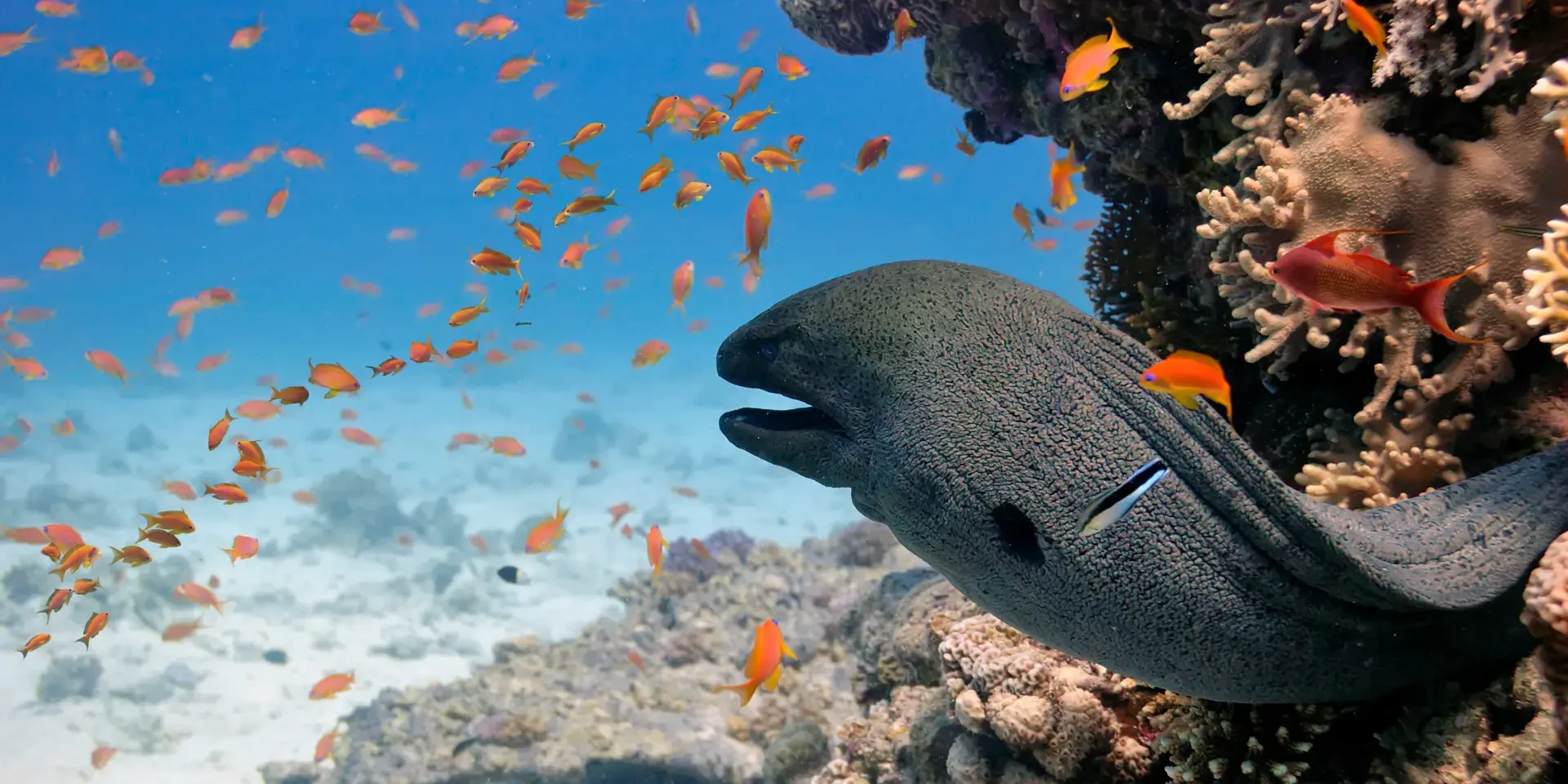
This is the most important fact to know about a moray eel. That constant opening and closing of their mouth, which can look like a threat display, has nothing to do with aggression. It’s simply how they breathe.
Unlike other fish that can swim in the open and pass water over their gills, morays live in tight spaces. They must actively pump water over their gills to extract oxygen. This action, called pharyngeal pumping, requires them to constantly and rhythmically open and close their mouths. They aren’t trying to bite you; they are literally just trying to breathe.
The Myth: They are Aggressive Sea Snakes
The Reality: They are Shy, Reclusive Fish.
First, morays are 100% fish, not reptiles. Their long, ribbon-like body is a perfect evolutionary adaptation for navigating the intricate, labyrinthine tunnels inside a coral reef.
Far from being aggressive, morays are incredibly shy and reclusive. They have relatively poor eyesight and rely almost entirely on an exceptionally powerful sense of smell to hunt. They spend their days in the safety of their chosen crevice, often staying in the same “house” for months or even years. They only become defensive if they feel cornered and threatened. When you see one, you are seeing an animal that is just trying to relax in its living room.
A Marvel of Evolution: The “Alien” Jaw
If their breathing is misunderstood, their hunting method is pure science fiction. Morays hunt prey (like fish and crabs) that is often too large to be swallowed whole. But living in a tight tunnel, they can’t open their mouths wide and create suction like other fish. So, evolution gave them a secret weapon.
Morays have a second set of jaws.
It’s called the pharyngeal jaw, and it’s located deep in their throat. When a moray bites its prey with its main jaws, this second “alien” jaw shoots forward from its throat, grabs the struggling prey, and physically pulls it back down into the esophagus for swallowing. It is a unique and incredibly effective adaptation that makes them one of the reef’s most successful predators.

A Guide to the Morays of Hurghada
When you dive with us, you have the chance to meet several different species. Here are a few of our most common residents:
- The Giant Moray (Gymnothorax javanicus): This is the king. The largest of the Red Sea morays, it can grow up to 3 meters (10 feet) long. Its mottled, leopard-like skin and sheer size make it an awesome and imposing sight. It is the apex predator of the reef’s crevices.
- The Yellow-mouthed Moray (Gymnothorax nudivomer): Perhaps the most beautiful, this moray has a dark, leopard-spotted body and a stunningly bright yellow or orange interior of its mouth, which you can see as it breathes.
- The Snowflake Moray (Echidna nebulosa): A truly beautiful and “friendlier” looking eel. Its white, black, and yellow “snowflake” pattern is gorgeous. Unlike other morays, it has blunt, pebble-like teeth, perfectly designed for its preferred diet of hard-shelled crabs and shrimp.
- The Geometric Moray (Gymnothorax griseus): Also called the Peppered Moray, this is a slender, greyish-white eel covered in fine black speckles. You will often see dozens of them poking their heads out of small holes in a sandy slope, looking like a field of tiny, curious periscopes.
The Reef’s Spa: A Partnership for Health
One of the most magical behaviours to witness is the partnership between a moray and a cleaner shrimp. You will often see a moray with its head out of a hole and its mouth wide open, allowing tiny, brave cleaner shrimp to walk fearlessly all over its face and inside its mouth and gills.
The shrimp are performing a vital service, picking off parasites, dead skin, and food particles. The moray gets a full health spa treatment, and the shrimp gets a free meal and is protected from its own predators by the eel’s intimidating presence. It’s a perfect example of trust and symbiosis, and a behaviour you’ll only spot if you approach calmly and slowly.
The Scubadore Way: How to Watch Morays Respectfully
Our entire philosophy of diving slowly in small groups is perfectly suited to observing morays. They are a reward for the patient diver.
- Never, Ever Put Your Hands in a Hole. This is the number one rule of reef diving. It’s not just for your safety, but for the animal’s. You are invading its home and will be seen as a threat.
- Keep a Respectful Distance. Don’t crowd the crevice. Use your camera’s zoom. A calm, relaxed diver is not a threat and will get to witness the eel’s natural, calm breathing behaviour.
- Move Slowly. A small, calm, slow-moving group (our specialty) will always see more than a large, fast-moving one. We don’t just swim past the reef; we explore it.
- Trust Your Guide. Our guides are experts at spotting morays and, more importantly, at reading their body language. We can tell the difference between a relaxed eel and a stressed one, ensuring the encounter is safe and positive for both you and the eel.
The moray eel is not a monster. It is a marvel of evolution—a shy, complex, and essential guardian of the reef’s inner world. On your next dive with us, don’t swim past that dark crevice. Pause. Hover. Look closer. You might just meet the most fascinating creature on the reef.