The Hidden Gems of Hurghada’s Reefs: Underrated Marine Species You’ll Love to Spot
When we dream of diving in the Red Sea, our minds often fill with images of charismatic megafauna: a graceful turtle gliding by, a majestic Napoleon Wrasse appearing from the blue, or a pod of dolphins playing in the bow wave. These are undeniably magical, “bucket-list” encounters. But to focus only on the big stuff is to miss the intricate, vibrant, and often bizarre world of wonders that lies hidden in plain sight on the reefs of Hurghada.
These are the hidden gems. The underrated, overlooked, and utterly fascinating creatures that make every dive a true treasure hunt. At Scubadore Hurghada, our passion lies in slowing down and truly looking at the reef. Our small-group philosophy allows us the time to explore, to peer into crevices, and to introduce our guests to the cast of smaller characters that make our underwater world so rich.
Let’s pull back the curtain on five of our favourite hidden gems—the marine species of the Red Sea you’ll absolutely love to spot on your next dive with us.

A lone peacock mantis shrimp in Hurghada.
1. The Peacock Mantis Shrimp (Odontodactylus scyllarus)
Don’t let the name “shrimp” fool you; this is no delicate, retiring crustacean. The Peacock Mantis Shrimp is one of the most formidable and fascinating predators on the reef. First, it’s visually stunning, boasting an iridescent, psychedelic shell of electric blues, greens, oranges, and reds. It has a pair of large, independently moving eyes on stalks, giving it an alien-like appearance as it peers out from its burrow in the rubble.
But its true superpower lies in its “dactyl clubs”—two appendages that it can deploy with lightning speed. Its punch is one of the fastest movements in the animal kingdom, accelerating at over 10,000 g’s and reaching speeds of 23 meters per second (51 mph) from a standing start. The strike is so fast it boils the water in front of it, creating a secondary shockwave that can stun or kill prey even if the initial punch misses. They use this incredible weapon to smash open the shells of their favourite food: crabs, clams, and snails. Spotting one of these vibrant, powerful hunters is a true thrill.

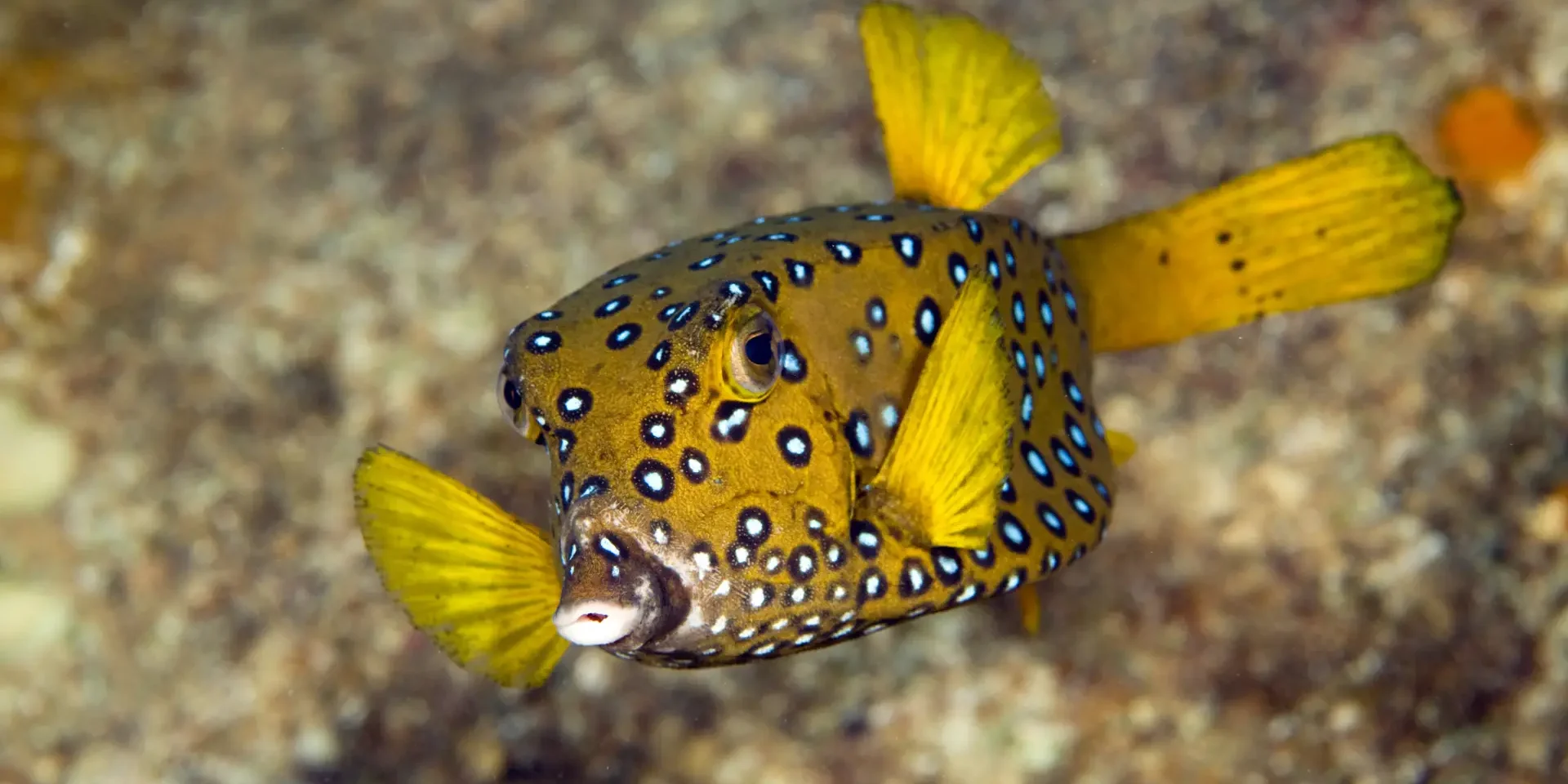
A juvenile yellow box fish.
2. The Yellow Boxfish (Ostracion cubicus)
Swimming awkwardly above the reef, the Yellow Boxfish is a delightful and comical sight. As a juvenile, it’s a tiny, brilliant-yellow cube with black polka dots, looking more like a child’s toy than a fish. Its boxy shape comes from a rigid, bony carapace that protects it from predators. This armour, however, makes it a clumsy and slow swimmer, relying on the gentle fluttering of its tiny fins to propel itself.
As it matures, it loses its bright yellow colour, transitioning to a more muted greenish-brown, but it never loses its charmingly awkward shape. What makes the boxfish a true gem is not just its appearance, but its clever defense mechanism. When stressed, it can secrete a toxic poison (ostraciotoxin) from its skin into the surrounding water, deterring any would-be aggressors. Finding one of these little armoured oddballs is guaranteed to bring a smile to your face.

The Blue Dragon nudibranch
3. Nudibranchs (Various Species)
Welcome to the wild world of sea slugs. The term “slug” does a profound disservice to these incredibly beautiful and diverse creatures. Nudibranchs are shell-less molluscs that come in a mind-boggling array of colours, shapes, and sizes, earning them nicknames like “sea dragons,” “butterflies of the sea,” and “living jewels.”
The Red Sea is home to many stunning species, including the magnificent Spanish Dancer (Hexabranchus sanguineus), a large, bright-red nudibranch that can unfurl its mantle and “dance” or swim through the water column in a mesmerizing display. On a much smaller scale, you might find the beautiful Blue Dragon (Glaucus atlanticus) or the intricately patterned Chromodoris quadricolor. Finding a nudibranch requires a keen eye and a slow pace. They are often found on specific sponges or hydroids which they feed on, and their vibrant colours serve as a warning to predators that they are toxic or taste terrible.

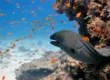
Masked pufferfish in reef.
4. The Masked Pufferfish (Arothron diadematus)
Endemic to the Red Sea, the Masked Pufferfish is a charismatic character you won’t find anywhere else on Earth. It’s easily identified by its greyish body and the striking black “mask” that covers its eyes and pectoral fins, making it look like a little underwater bandit. It has large, expressive eyes and an almost comical, beak-like mouth which it uses to crush the shells of crustaceans and molluscs.
Like all pufferfish, it has two impressive defense mechanisms. When threatened, it can inflate its body with water, turning itself into a large, spiky, and inedible ball. Secondly, its internal organs contain a potent neurotoxin called tetrodotoxin. You’ll often see them hovering just above the reef, their fins working overtime. Their inquisitive nature makes them a favourite among divers and photographers.

Flagtail Shrimpgoby with Randall’s snapping shrimp
5. Shrimp Gobies & Their Pistol Shrimp Partners
This is not one creature, but two, living together in one of the most fascinating symbiotic relationships on the reef. You have to hover patiently over a sandy patch to witness this marvel. You’ll first see the Shrimp Goby (various species), a small fish sitting sentinel at the entrance to a small burrow.
But the goby is not alone. It stands guard for its roommate, a nearly blind Pistol Shrimp. The industrious shrimp is the housekeeper, constantly digging and maintaining the burrow they both share. In return for a safe home, the goby acts as the shrimp’s eyes. The shrimp will almost always keep one of its long antennae on the goby’s body. If the goby senses danger, it gives a specific tail flick, and both fish vanish into the burrow in a flash. Witnessing this perfect partnership of dedicated teamwork requires patience and a gentle approach—qualities at the heart of the Scubadore diving philosophy.
Finding the Gems with Scubadore Hurghada
The thrill of spotting these hidden wonders is what turns a good dive into an unforgettable one. It requires a shift in perspective—from seeking out the big and obvious to appreciating the small and intricate. This is where our small-group approach makes all the difference. We don’t rush from one end of the reef to the other. We move slowly, we observe, and we give you the time to truly explore. Our expert guides have a knack for finding these cryptic creatures and a passion for sharing these discoveries with you.
On your next trip to Hurghada, challenge yourself to look closer. The giants of the reef are magnificent, but the hidden gems are where the true treasure lies.