The Lionfish: Beautiful Invader or Native Guardian? Understanding Their Role in the Red Sea
 If you have ever dived in the Caribbean or off the coast of Florida, you likely know the Lionfish as “Public Enemy Number One.” In the Atlantic, they are a devastating invasive species, wiping out native fish populations with no natural predators to stop them. Divers there are encouraged to hunt them on sight.
But here in the Red Sea, the story is completely different.
When you spot a Common Lionfish (Pterois miles) on a reef in Hurghada, you aren’t looking at an invader. You are looking at a native, balanced, and essential part of our marine ecosystem. In fact, the Red Sea is their original home.
At Scubadore Hurghada, we often have to stop enthusiastic American divers from trying to “save the reef” by hunting them! Here is the truth about the Lionfish in its own backyard.
Native vs. Invasive: Context is Everything
In the Atlantic, the Lionfish is a monster because the local fish don’t recognize it as a predator. It eats everything, breeds rapidly, and nothing eats it back.
In the Red Sea and Indo-Pacific, the Lionfish has evolved over millions of years alongside its prey and its predators.
-
The Prey: Small fish here know exactly what a Lionfish is. They have evolved behaviors to avoid being eaten, keeping the Lionfish population in check.
-
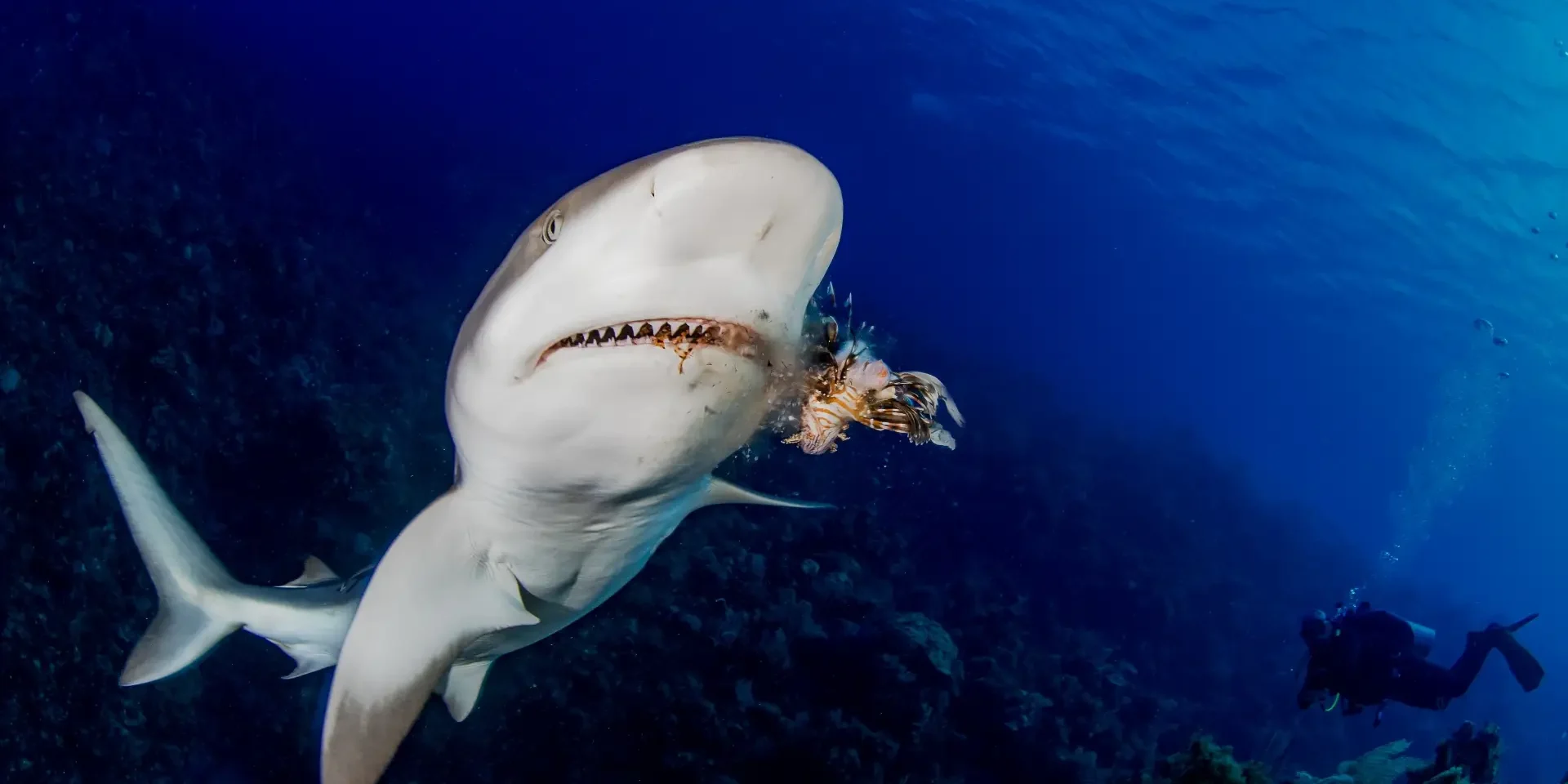
The Predators: Large groupers, snappers, sharks, and even Moray Eels in the Red Sea are known to eat Lionfish. They are part of the food web, not the top of it.
The Beauty of the Beast
Because they are native here, we can appreciate them for what they are: one of the most beautiful and photogenic fish on the reef.
-
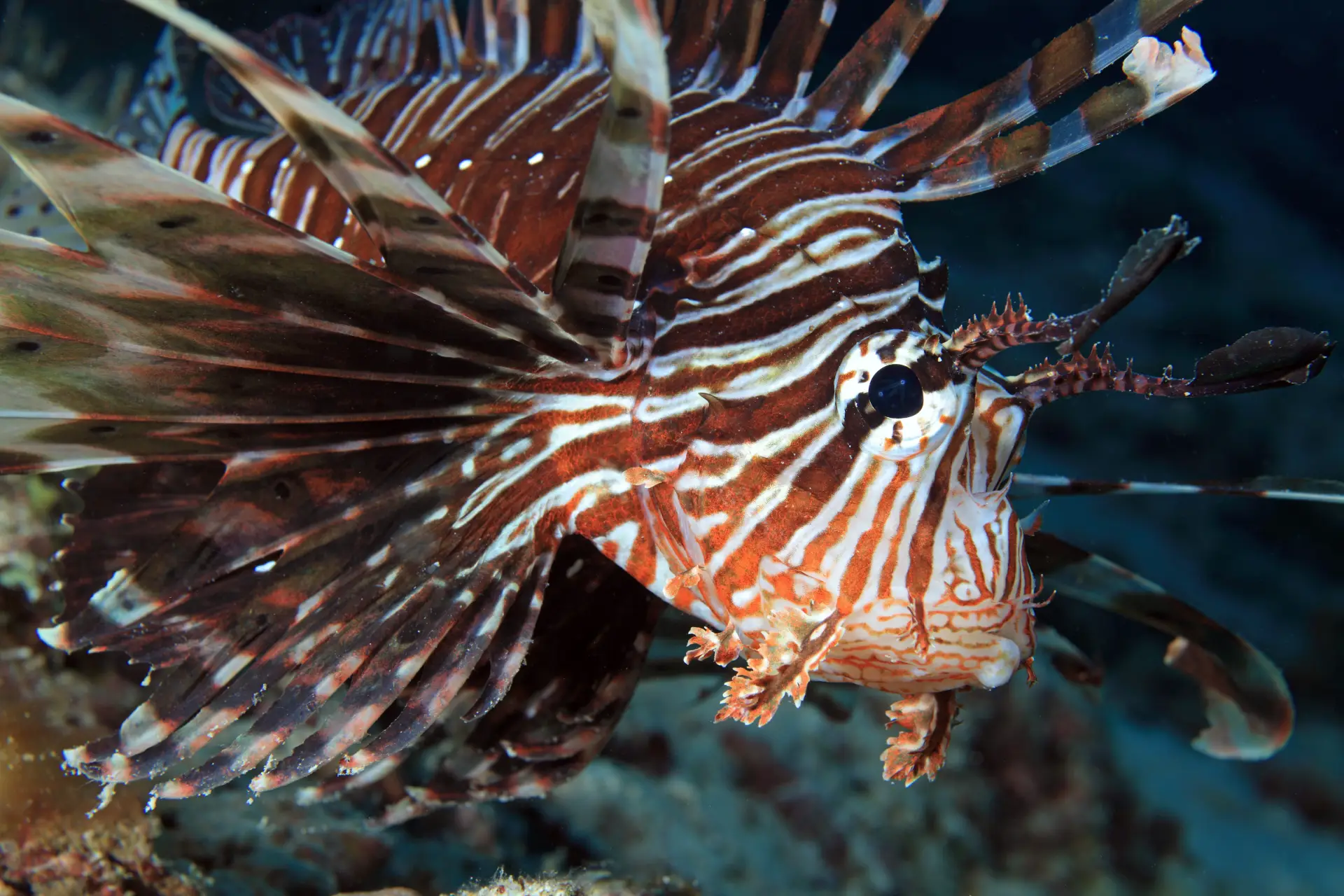
The Plumage: With their fan-like pectoral fins and tall, spiked dorsal fins, they look like underwater peacocks.
-
The Behavior: They are confident and slow-moving. They don’t dart away like other fish. They will hover, turn, and flare their fins at divers, allowing for spectacular, close-up photography.
-
The Hunt: Watch them at dusk. They use their large pectoral fins like herding dogs, cornering small fish against the reef before striking with lightning speed. It is a mesmerizing display of cooperative hunting.
The Danger: Look But Don’t Touch
While they are ecologically safe here, they are still physically dangerous to divers.
The Lionfish is a member of the Scorpaenidae family (scorpionfish). It possesses 18 venomous spines (13 dorsal, 3 anal, 2 pelvic).
-
The Sting: The venom is protein-based and causes excruciating pain, swelling, and in rare cases, systemic reactions. It is not usually fatal to humans, but it will absolutely ruin your dive trip.
-
The Heat Treatment: If you are stung, the immediate first aid is hot water (as hot as you can stand without burning). Heat breaks down the protein in the venom, neutralizing the pain.
The Scubadore Rule: Respect the Local
So, the next time you see a Lionfish in Hurghada:
-
Don’t Hunt: Put the spear away. In the Red Sea, killing a Lionfish is damaging the native ecosystem, not saving it.
-
Admire the Confidence: Watch how they move. They own the reef.
-
Mind Your Buoyancy: They often hover in mid-water or under ledges. Accidents happen when divers crash into them, not when the fish attacks.
The Lionfish is a perfect example of how context changes everything. In Florida, it’s a villain. In Hurghada, it’s a beautiful, native guardian of the reef.