When you descend into the vibrant chaos of the Red Sea, your eyes are immediately drawn to the large, dynamic features: the majestic turtle grazing on the reef, the swirling schools of fish, and the vast, colourful coral structures. But to appreciate the true mastery of this ecosystem, you must stop looking at the stage and start looking at the actors hidden in the scenery.
Welcome to the hidden world of camouflaged predators.
The Red Sea is home to some of the world’s most fascinating and dangerous masters of disguise—creatures whose entire existence relies on disappearing into their surroundings. They are the ultimate sit-and-wait hunters. While their incredible camouflage is a marvel of evolution, it requires a careful, responsible, and expert approach to observation.
At Scubadore Hurghada, our expert guides consider spotting these cryptic critters one of the greatest rewards of the dive. It requires patience, a keen eye, and a profound commitment to buoyancy control.

The Ultimate Ambush Predator: The Stonefish (Synanceia verrucosa)
The Stonefish is the most famous, and most feared, of the Red Sea’s camouflaged residents—and for good reason. It is officially the most venomous fish in the world. Yet, its presence is a remarkable testament to the wild, balanced nature of our ecosystem.
The Masterpiece of Mimicry
The Stonefish looks exactly like a lumpy, algae-covered rock or piece of coral rubble. Its body is covered in fleshy tabs and knobs, and its mottled coloration of brown, green, and beige allows it to blend seamlessly into the sandy, rubble-strewn areas where it prefers to lie motionless.
The Critical Safety Rule
The danger from the Stonefish is purely defensive. It is not aggressive and will not chase you. The risk occurs when an unaware diver or swimmer accidentally puts pressure on it by kneeling down, touching a patch of reef, or stepping on it in the shallows. When pressure is applied, 13 incredibly sharp, venomous spines on its dorsal fin pop up, injecting a potent, protein-based venom.
This is why we stress and teach perfect buoyancy control (PPB) on every dive. The rule is absolute: never touch the bottom, and never place your hands into holes or crevices. Our guides are trained to spot these creatures, transforming a potential hazard into a fascinating and safe observation opportunity.

The Carpet in Motion: The Crocodilefish (Papilloculiceps longiceps)
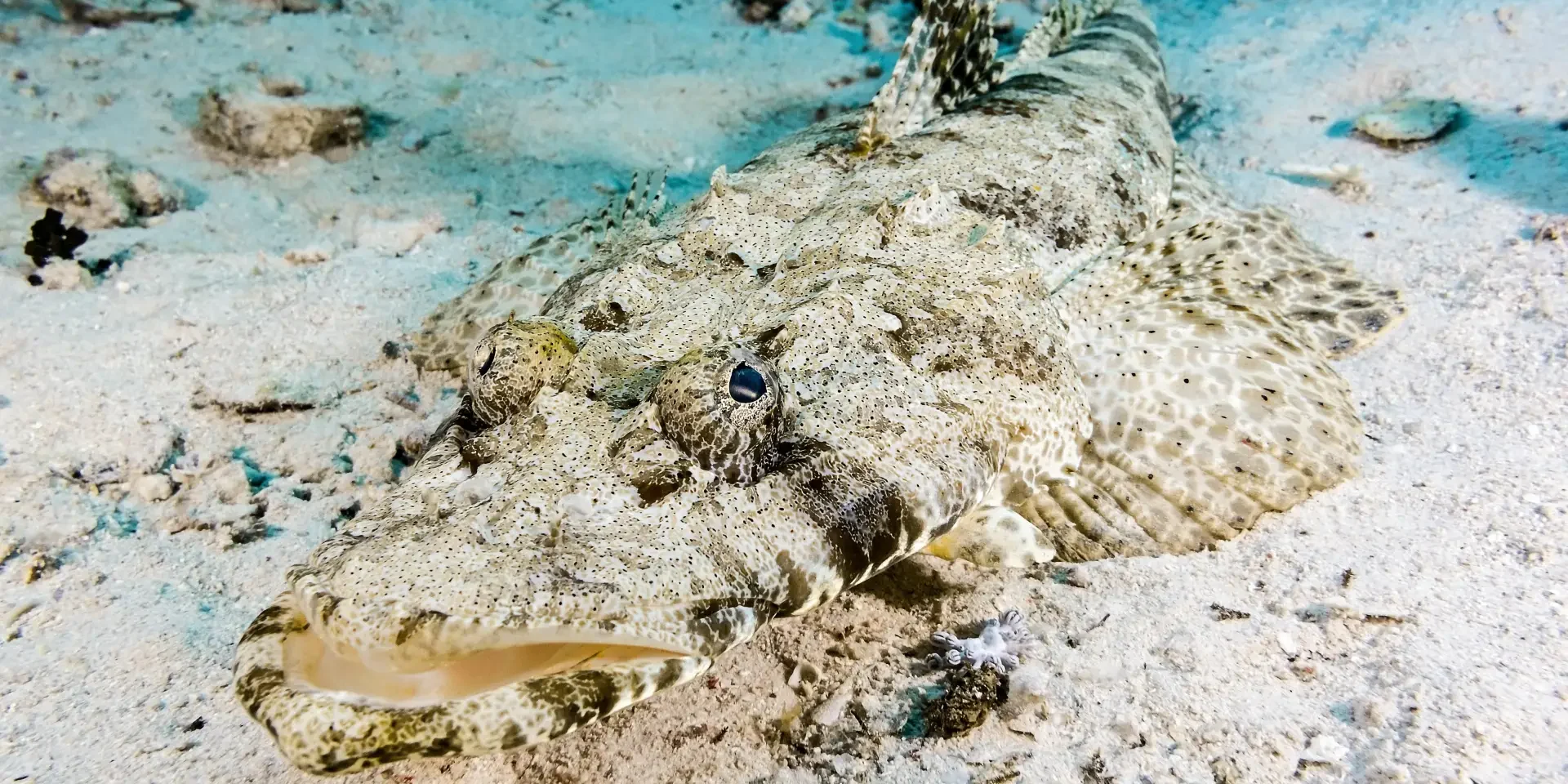
This magnificent fish is a true favorite among underwater photographers and observant divers. The Crocodilefish, or Tentacled Flathead, earns its name from its broad, flat head and elongated body, which gives it a distinctly reptilian appearance.
The Art of Invisibility
The Crocodilefish is the king of the sandy bottom. Its body is covered in a mosaic-like pattern of brown, beige, and green that perfectly matches the sea floor. Its eyes are positioned high on its head, giving it a 360-degree view, and it has specialized, frilly lappets over its eyes. These frills break up the outline of the eye’s black iris, making its features disappear into the background.
It spends its time lying perfectly motionless, often partially buried in the sand, waiting patiently for small fish or crustaceans to wander by. The reward for finding one is watching it suddenly reveal its distinct pattern as it uses its large pectoral fins to gracefully glide a short distance across the sand before settling again.

The Scorpionfish Family: The Reef’s Assassins
The Stonefish and Crocodilefish are both members of the broader Scorpionfish family (Scorpaenidae), which is characterized by venomous spines and expert camouflage. The Red Sea is home to several variations:
- The Devil Scorpionfish: A knobby, warty, and mottled creature that often mimics algae-covered rocks. You’ll find it perched on coral heads or rocky outcrops, waiting for prey.
- The Lionfish: While flamboyant, the Lionfish (a type of scorpionfish) uses its dramatic stripes and feathery fins to corral small prey before quickly swallowing it. Its dorsal spines are highly venomous and used for defense.
The Common Thread:
All of these fish rely on the same simple, effective hunting strategy: Ambush. They are not active swimmers. They are the ultimate example of energy efficiency, waiting for hours for a meal to come to them.
The Scubadore Code: How to Spot and Respect
Spotting these camouflaged hunters requires a specific, disciplined approach to diving. Our small-group philosophy is perfectly suited for this demanding form of underwater treasure hunting.
1. The Two-Part Look
When scanning the bottom, use the two-part look: First, look for the big picture (turtles, rays). Second, slow down and look for irregularity. Look for a pattern that seems too perfect, a rock with an eye, or a piece of rubble with fins. The moment your eyes adjust, the whole reef comes to life.
2. Light Up the Details
Carry a dive torch, even during the day. The beam of light cuts through the shadows and dramatically enhances the colours and textures of these camouflaged creatures, revealing the beautiful mosaic patterns on a Crocodilefish or the rich colours of a hiding Scorpionfish.
3. Zero-Impact Observation
These are delicate and sometimes dangerous encounters, requiring the utmost respect.
- Buoyancy is Life: Your buoyancy is the key to safety and reef protection. You must be able to hover above the animal without kicking sand or descending onto the reef.
- Use Your Guide’s Eyes: Our expert local guides spend hours training their eyes to find these subtle creatures. They will be your best asset in spotting a Stonefish that you would otherwise swim directly over.
- Never Provoke: Never poke, prod, or attempt to move any of these creatures. A clean observation from a safe distance is the only way to dive.
The Red Sea’s camouflaged hunters are silent, beautiful, and essential guardians of the reef’s balance. We invite you to test your spotting skills with us and discover the thrilling, hidden world that lies just beneath the surface of the sand.