Real-Life Nemo: The Symbiotic World of the Red Sea’s Clownfish and Anemones
If you ask any child (or honest adult) what they most want to see underwater, the answer is almost always the same: “Nemo.”
Thanks to Pixar, the Clownfish is the most recognizable fish in the ocean. But the real-life story of the Clownfish and its home, the Anemone, is far more fascinating than any movie script. It is a story of biological warfare, chemical trickery, and a partnership so tight that neither creature can survive in the wild without the other.
In Hurghada, we are spoiled. The Red Sea Clownfish (Amphiprion bicinctus) is abundant on almost every reef we dive. But how often do you stop to truly watch them? At Scubadore Hurghada, we believe that understanding the science behind the scene makes the encounter infinitely more magical.
Here is a deep dive into the most famous roommates in the Red Sea.
The Players: Meet the Red Sea Local
While there are 30 species of Clownfish worldwide, the one you will meet on our dives is the Red Sea Anemonefish (also known as the Two-banded Anemonefish).
It is a stunning creature, distinctive for its rich golden-orange body and two stark white vertical bars outlined in black. Unlike its Pacific cousins, our local variety often has a bright yellow tail. They are feisty, curious, and fiercely territorial—a personality that seems far too big for their small size.
The Deal: What is Symbiosis?
In biology, this relationship is called Mutualism—a type of symbiosis where both parties benefit. Think of it as a rental agreement where the tenant pays in services rather than cash.
What the Anemone Provides (The Fortress)
The sea anemone is not a plant; it is a predatory animal related to jellyfish. Its tentacles are armed with thousands of microscopic harpoons called nematocysts that fire neurotoxins on contact.
-
Protection: This is the ultimate security system. A predator trying to eat a Clownfish has to face a wall of stinging tentacles.
-
A Nursery: The Clownfish lays its eggs on the rock at the base of the anemone, where they are protected by the stinging canopy above.
What the Clownfish Provides (The Services)
The Clownfish isn’t a squatter; it’s the hardest working tenant on the reef.
-
The Bodyguard: Butterflyfish love to eat anemone tentacles. The Clownfish, despite its size, will aggressively attack and chase away any fish (or diver!) that gets too close to its host.
-
The Housekeeper: Clownfish eat parasites and dead matter from the anemone, keeping it clean and healthy.
-
The Waiter: When the Clownfish eats, scraps of food fall into the anemone, providing it with a free meal.
-
The Fertilizer: This is the unglamorous part. Clownfish waste is rich in ammonia and nitrogen, which acts as a high-grade fertilizer for the symbiotic algae living inside the anemone’s tissues.
The Magic Trick: Why Don’t They Get Stung?
This is the most common question we get. If the anemone stings everything else, why not the Clownfish?
The answer lies in chemistry.
The anemone doesn’t “know” not to sting the Clownfish; the Clownfish tricks it. The fish is covered in a specialized layer of mucus that mimics the chemical makeup of the anemone itself. essentially, the Clownfish wears an “invisibility cloak.” When the tentacles touch the fish, the anemone thinks it is touching its own body, so the stinging cells do not fire.
Fascinating Fact: This immunity isn’t automatic. If a Clownfish is separated from its host for a long time, it can lose its protection. It has to perform a “dance,” gently touching the tentacles with its belly and fins for hours to re-acclimate and build up that mucus layer again.
The Gender-Bending Reality
Here is the part Disney left out. All Clownfish are born male.
They live in a strict hierarchy based on size. The largest, most dominant fish in the anemone is the Female. The second largest is the breeding Male. All the smaller fish are non-breeding males.
If the female dies (or is eaten), the breeding male doesn’t go look for a new girlfriend. Instead, he undergoes a biological change and becomes the female. The largest of the non-breeding males then grows up to become the new breeding partner. It’s a ruthless but efficient way to ensure the lineage continues without ever leaving the safety of the anemone.
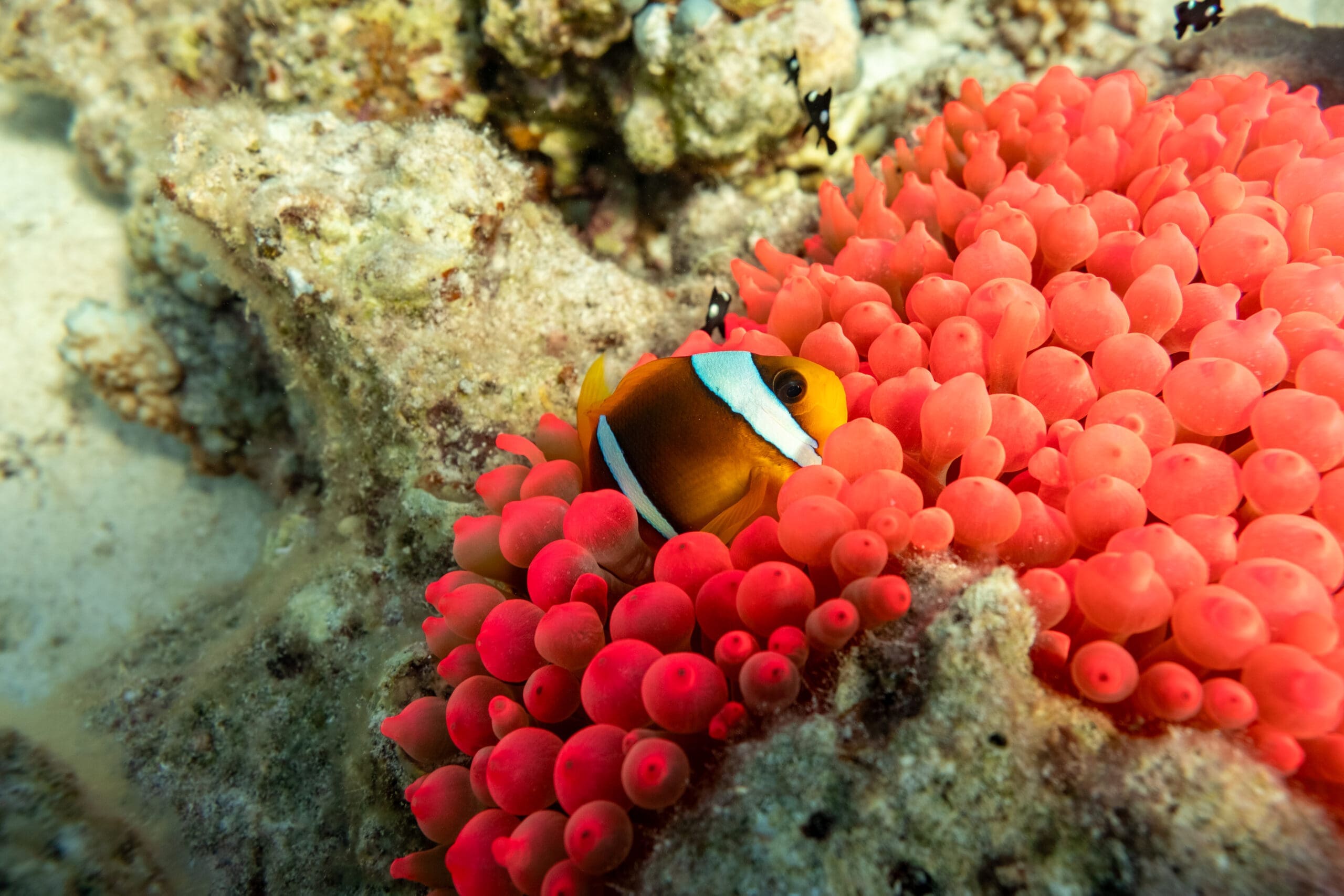
Clownfisch oder Nemo in roter Anemone bei Tauchgang mit scubadore hurghada
How to Observe Them with Scubadore
Because Clownfish never leave their home, they are the perfect subject for observation. But to see the real magic, you need to be patient and still.
-
Look for the Eggs: If the Clownfish are being particularly aggressive or darting frequently to the base of the anemone, look closely (but don’t touch!). You might see a patch of hundreds of tiny orange or silver eggs glued to the rock.
-
Watch the Fins: Notice how the Clownfish constantly wiggles and fans its fins? It’s not just swimming; it’s aerating the water, increasing oxygen flow to the anemone and the eggs.
-
Don’t Stress the Host: Never poke an anemone to see it close. This stresses the animal and collapses the “fortress,” leaving the Clownfish vulnerable to predators.
Come Find “Nemo” with Us
The Red Sea Clownfish is a small fish with a massive story. It’s a warrior, a housekeeper, and a master of disguise.
On your next dive with Scubadore Hurghada, ask your guide to point out an Anemone City. Instead of swimming past, stop. Hover. Watch the intricate dance of life happening in that small patch of tentacles. It’s a perfect example of how amazing nature can be when we take the time to look.