Ask any seasoned Red Sea diver what creature gets their heart racing, and they probably won’t say “shark.” They will likely tell you about a fish with a goofy moustache, buck teeth, and an attitude problem: The Titan Triggerfish.
The Titan (Balistoides viridescens) is the heavyweight of the reef. While usually a peaceful, industrious cruncher of coral, it undergoes a personality transplant during nesting season. It becomes fiercely territorial, fearless, and willing to take on anything that enters its zone—including divers ten times its size.
But here is the truth: The Titan isn’t “mean” or “aggressive.” It is simply a dedicated parent.
At Scubadore Hurghada, we believe in respecting every resident of the reef. The key to diving safely with Titans isn’t fear; it’s knowledge. Here is your guide to identifying the warning signs, understanding the “Cone of Danger,” and exiting an encounter with your fins (and dignity) intact.
1. Identification: Spotting the “Mustachioed Heavyweight”
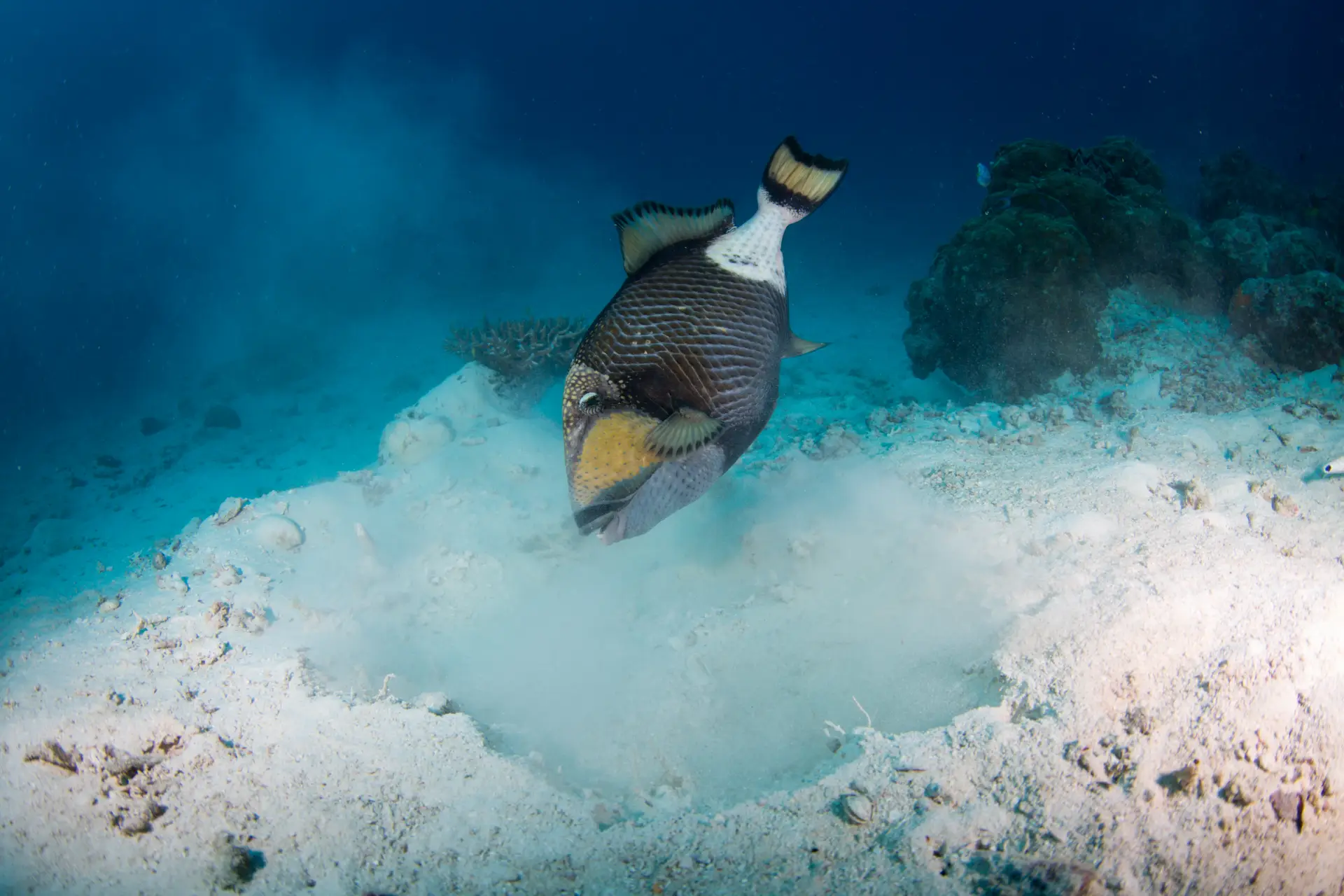 The first step to safety is spotting them before they spot you. Titans are the largest triggerfish in our waters, growing up to 75cm long.
-
The Look: They are robust and oval-shaped. Look for a distinctive cross-hatch pattern on their scales (giving a dark, greenish-grey appearance) and bright yellow/orange margins on their fins.
-
The Face: They have a very distinct dark “moustache” above their upper lip.
-
The Teeth: They possess powerful, human-like teeth designed for crushing clams and coral. You don’t want to test these!
-
The Eyes: Like chameleons, their eyes move independently. If you see one eye swiveling to track you while the fish is stationary, it is watching you closely.
2. The “Trigger”: Knowing the Warning Signs
The Titan usually gives you a warning before it charges. The name “Triggerfish” comes from their dorsal fin anatomy.
They have a large first dorsal spine that can be locked in an upright position by a second, smaller “trigger” spine.
-
Fin Down: The fish is relaxed.
-
Fin Up (The Unicorn): If you see that spine pop up and lock into place, caution. The fish is agitated or feeling threatened.
-
The “Side Roll”: If the fish turns on its side to look at you with one eye, it is assessing you as a threat. Back off immediately.
3. The Danger Zone: Understanding the “Cone”
This is the most critical piece of knowledge for any diver.
When a Titan is nesting, it digs a large crater in the sand to lay its eggs. It will guard the water column directly above this nest. However, the territory is not a sphere; it is an inverted cone that starts at the nest and widens as it goes up to the surface.
The Mistake Divers Make: When a Titan becomes aggressive, a diver’s instinct is often to swim up. Why this fails: Swimming up keeps you inside the cone. In fact, as the cone widens, you are actually moving deeper into their territory. The fish will chase you all the way to the surface.
The Solution: You must swim horizontally (away from the nest) to exit the cone. Stay low, close to the reef, and swim quickly away from the nesting site.
4. Safety Protocol: What to Do If It Charges
If you accidentally stumble into a nesting zone and a Titan charges:
-
Don’t Panic: It’s easier said than done, but panic leads to rapid breathing and poor decisions.
-
Fins First: Roll onto your back or side and put your fins between you and the fish. The Titan is looking to bite the intruder. Let it bite your hard plastic fin, not your soft wetsuit!
-
Kick and Retreat: Use your fins to create a barrier and distance while swimming horizontally away from the nest.
-
Watch Your Buddy: Often, a Titan will focus on one diver. If you see your buddy being chased, signal them to swim away horizontally (not up!).
5. When is “Nesting Season”?
While Titans can be territorial year-round, they are most active during the summer months (typically July to September in the Red Sea). During this time, be extra vigilant when diving over sandy plateaus or near coral rubble zones where they prefer to build their nests.
The Scubadore Advantage
The best way to avoid a Titan encounter is to have a guide who knows exactly where the nests are. Our local guides dive these reefs every day. We know which “Mrs. Titan” is currently nesting at which site, and we plan our dive paths to give her a wide, respectful berth.
With Scubadore Hurghada, you can observe these fascinating, powerful parents from a safe distance, appreciating their dedication without ever entering the danger zone.