The Eight-Armed Enigma: Unmasking the Mind of the Red Sea Octopus
In the vibrant underwater cities of Hurghada, every dive reveals incredible marine life. We glide past shimmering schools of fish, marvel at majestic turtles, and admire the intricate architecture of the coral. But sometimes, if you are patient, observant, and truly lucky, you might just meet an intelligence that seems utterly alien, yet captivatingly familiar.
Welcome to the world of the octopus.
These eight-armed enigmas are widely considered the most intelligent of all invertebrates, and an encounter with one is often described as one of the most profound experiences a diver can have. It’s less like observing an animal and more like having a brief, silent conversation with a creature from another dimension.
At Scubadore Hurghada, our expert guides are masters of spotting the unseen. We understand that the greatest treasures of the Red Sea are not always the biggest or the brightest, but often the most elusive and intelligent. We take pride in slowing down, looking closer, and providing our guests with the chance to witness the astonishing capabilities of the Red Sea octopus.
More Than Meets the Eye: The Mind Behind the Mimicry
The octopus is a cephalopod, a relative of squid and cuttlefish, but it stands apart with its unparalleled cunning and adaptability. When you encounter an octopus in the Red Sea, you’re not just looking at a creature; you’re looking at a mind at work.
Three Hearts, Nine Brains, Blue Blood
Their biology is as unique as their intelligence. Octopuses have three hearts: two pump blood through the gills, and one circulates it to the rest of the body. Their blood is blue, due to a copper-based protein called hemocyanin, which is more efficient for oxygen transport in cold, low-oxygen water. What’s more, while they have a central brain, each of their eight arms also contains a cluster of nerve cells (a “mini-brain”), allowing the arms to act with a degree of independent thought. This distributed intelligence is truly remarkable.
Masters of Problem-Solving
In captivity, octopuses have baffled scientists with their ability to navigate mazes, open jars, and even escape seemingly secure tanks. Underwater, this translates into incredible hunting strategies and an uncanny knack for finding and securing shelter. They are curious and often playful, sometimes interacting briefly with divers before vanishing.
The Ultimate Shapeshifter: Camouflage Beyond Belief
This is perhaps the octopus’s most celebrated superpower. It’s not just about changing colour; it’s about complete, instantaneous metamorphosis.
- Chromatophores, Iridophores, and Leucophores: These specialized cells in their skin allow them to change their colour and pattern in milliseconds. Chromatophores expand and contract to reveal pigments like red, brown, and yellow. Iridophores reflect light to create iridescent greens and blues. Leucophores scatter white light.
- Papillae: The Texture Transformation: Even more astonishing, octopuses can activate tiny muscles in their skin called papillae to change their texture from smooth to bumpy, spiky, or ridged. This allows them to perfectly mimic sand, rock, or even soft coral, making them virtually invisible.
- More Than Just Hiding: Their camouflage isn’t just for evading predators. They use it aggressively for hunting, blending perfectly into the background before ambushing unsuspecting prey like crabs or small fish.
Watching an octopus “disappear” before your eyes, transforming its colour and texture in an instant, is one of the most incredible sights you will ever witness underwater.
The Elusive Hunter: When and Where to Spot Them
Spotting an octopus in the Red Sea is a reward for patience and a keen eye. They are experts at hiding and are typically most active during dawn and dusk. During the day, they are often tucked away in crevices, under rocks, or in small caves, using their camouflage to remain perfectly hidden.
When they do emerge, they “flow” across the reef, using their powerful suckers to explore every nook and cranny. They often carry shells or small rocks to build barricades around the entrance to their dens, demonstrating their advanced tool-using behaviour.
- Look for Irregularities: Instead of looking for an octopus shape, look for something that seems “off” in the reef, a texture or colour that doesn’t quite match.
- Follow the “Garbage”: Octopuses are tidy. If you see a small pile of broken shells or crab claws outside a crevice, it’s often a sign that an octopus is living inside.
- Patient Observation: Once you spot one, hover calmly and observe. If you don’t chase or threaten it, an octopus’s natural curiosity might lead it to observe you back, offering a truly magical moment of connection.
Species in the Red Sea:
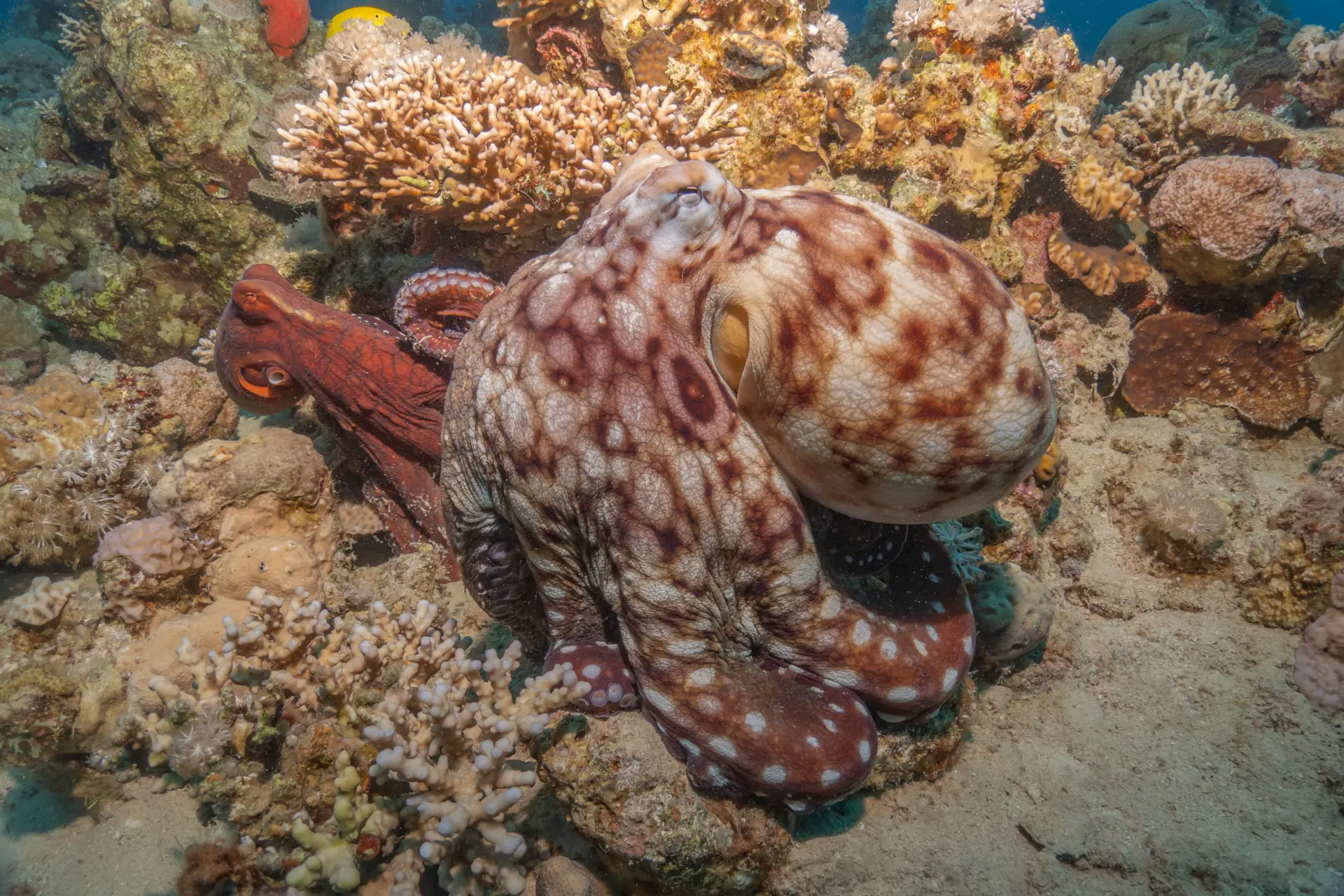
Common octopus
While several species exist, the Common Reef Octopus (Octopus cyanea) is the most frequently encountered in Hurghada. It’s typically a medium-sized octopus, known for its rapid colour changes and intelligence. You might also spot smaller, more reclusive species.
The Scubadore Advantage: Your Best Chance for an Encounter
Finding an octopus is not a guarantee, but our approach to diving significantly increases your chances:
- Small Groups: Fewer divers means less disturbance to the reef, making marine life (especially shy creatures like octopuses) more likely to emerge and behave naturally.
- Slow, Observant Dives: Our guides encourage a relaxed pace, giving you and them the time needed to thoroughly scan the reef for hidden gems. We teach you to look beyond the obvious.
- Expert Guides: Our divemasters and instructors spend thousands of hours on these reefs. They know the habits, hiding spots, and preferred feeding grounds of the local octopus populations.
An encounter with either a common octopus or a “Red Sea octopus” is a highlight that reminds us of the endless wonders hidden beneath the waves. It’s a testament to the fact that sometimes, the most intelligent and captivating creatures are the ones we have to work a little harder to find. Join us, and let’s see if we can unveil this eight-armed enigma together.