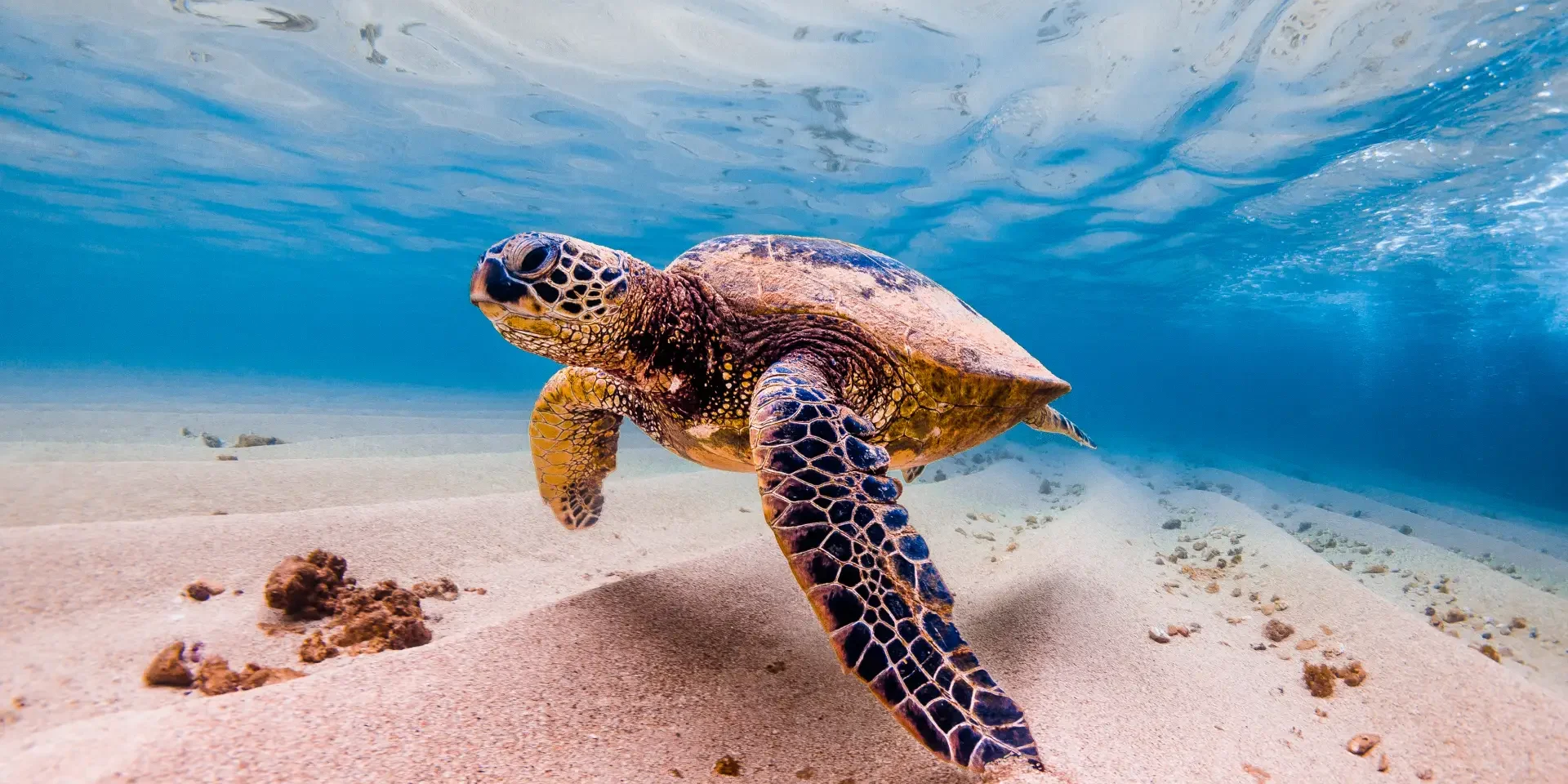
Of all the magnificent creatures that inhabit the Red Sea, perhaps none inspires such a deep sense of peace and wonder as the sea turtle. These ancient mariners, descendants of species that swam the world’s oceans alongside the dinosaurs, glide through the water with an effortless grace that is both humbling and mesmerizing.
For those who dream of sharing the water with these gentle giants, Hurghada is the perfect destination. The warm, clear waters and healthy ecosystems provide a reliable habitat for these protected species, making our reefs a true paradise for turtle lovers.
At Scubadore Hurghada, we consider every turtle sighting a gift. Our small-group philosophy ensures that these precious encounters are non-intrusive, allowing us to observe these beautiful animals behaving naturally in their element. Let us introduce you to the two great sea voyagers you can expect to meet on our dives.
The Two Great Sea Voyagers of Hurghada
The Red Sea is visited by five of the world’s seven sea turtle species, but two are resident and most commonly sighted near the Hurghada reefs and feeding grounds: the Green Sea Turtle and the Hawksbill Turtle.

1. The Hawksbill Turtle (Eretmochelys imbricata)
- Appearance & Identification: The Hawksbill is easily identified by its distinctive pointed face and narrow beak, which is perfect for reaching into crevices to extract its favourite food. Its carapace (shell) is often beautifully patterned with thick, overlapping scales called scutes, giving it a stunning, intricate look. They are generally smaller than Green Turtles.
- Habitat & Diet: Hawksbills are the reef specialists. Their diet consists mainly of sea sponges, which grow on coral structures. Because of this, you are most likely to find them swimming actively along a reef wall or resting near a coral outcrop in areas like the Giftun Islands.
- Conservation Status: Sadly, the Hawksbill Turtle is currently listed as Critically Endangered globally, making every single sighting even more precious.

2. The Green Sea Turtle (Chelonia mydas)
- Appearance & Identification: The Green Sea Turtle is the largest hard-shelled turtle in the world and has a much rounder, blunt face compared to the Hawksbill. As adults, their shells are smooth and their scales do not overlap. They are named for the greenish colour of their fat, not their shell.
- Habitat & Diet: Green Turtles are the grazers of the sea. While juveniles are carnivorous, adults are primarily herbivorous, feeding almost exclusively on seagrass and algae. You are most likely to find these larger turtles grazing peacefully in the shallow, sandy bays and seagrass beds common in the Hurghada area.
- Conservation Status: The Green Sea Turtle is listed as Endangered globally, facing significant threats from habitat loss and pollution.
Why Hurghada is a Reliable Turtle Hotspot
Our region provides the perfect environment for both species to thrive:
- Abundant Food Sources: The reefs provide the Hawksbills with sponges, and crucial seagrass meadows (vital near the Giftun National Park) ensure the Green Turtles have their primary food source readily available.
- Warm, Stable Water: The consistent, warm temperatures of the Red Sea allow turtles to feed and remain active year-round without the need for large-scale migration.
- Marine Protected Areas: The establishment of the Giftun Island National Park means that critical feeding and resting grounds are protected from fishing and habitat destruction, giving these populations a much-needed sanctuary.
The Responsible Encounter: Scubadore’s Guide to Observation
An encounter with a sea turtle is a privilege that comes with a solemn responsibility. Our priority is always the well-being of the animal, ensuring our presence is non-intrusive and stress-free for them.
The Golden Rules of Observation
- Never Touch: Never, under any circumstances, touch or try to ride a sea turtle. Touching them removes the protective layer of mucus on their shell, making them vulnerable to infection and disease.
- Respect Their Path: A turtle must surface to breathe. Never block their path to the surface, and ensure you stay out of their way if they are heading up for air.
- Stay Behind or Beside: Always approach from the side, allowing the turtle to see you. Never approach head-on or from behind, as this can startle them.
- Maintain Distance: Stay at least 4-5 meters away. Let the turtle dictate the encounter. If they are comfortable, they will often continue to feed or rest, allowing you to observe them naturally. If a turtle swims away, it’s a sign of stress—respect the boundary and do not chase.
The Scubadore Advantage: Non-Intrusive Encounters
Our small-group diving philosophy is the best way to ensure responsible encounters. A large group of divers is intimidating and will often cause a turtle to leave the area immediately. By moving slowly and calmly with only a handful of divers and an expert guide, we significantly increase the chance of a long, intimate, and non-stressful observation, allowing the turtle to exhibit its natural, peaceful behavior.
The Bigger Picture: Threats and Hope
Despite the sanctuary provided by the Red Sea, these species face significant global threats, primarily from plastic pollution (mistaking plastic bags for jellyfish), entanglement in fishing gear, and the impact of climate change on nesting beaches.
By choosing to dive with a responsible operator like Scubadore Hurghada and adhering to the “look, don’t touch” rules of the Giftun National Park, you become a direct participant in conservation. Every responsible, respectful encounter reinforces the economic value of a living turtle over an exploited one, guaranteeing these graceful ancient mariners will continue to thrive in the clear waters of Hurghada for centuries to come.